Clocks Change Twice This Fall: The Week Europe and the US Are Out of Sync
Twice this fall, the clocks fall back, and they don't do it on the same day. Europe goes first, on Sunday, October 25. The United States and Canada follow a week later, on Sunday, November 1. For the seven days in between, the usual gaps across the Atlantic are an hour shorter than you're used to. That's the week a standing call, a connection, or a rental car pickup is most likely to land at the wrong hour.
The Dates
- Europe and the UK: Sunday, October 25. At 01:00 UTC every country on European summer time falls back an hour at once. In London that's 2:00 a.m. BST becoming 1:00 a.m. GMT; in Paris and Frankfurt, 3:00 a.m. becoming 2:00 a.m.
- The US and Canada: Sunday, November 1. Each time zone falls back at 2:00 a.m. its own local time, so the change rolls west across the country over a few hours.
- The southern hemisphere already moved forward. Chile on September 6, New Zealand on September 27, and Sydney on October 4. Their summer is starting, so their gap to Europe and North America has been growing, not shrinking.
- Many places don't change at all: Phoenix, Honolulu, Mexico City (since 2022), São Paulo, Istanbul, Dubai, Delhi, Singapore, and Tokyo stay put. Their gap to everyone else moves only because the other side changes.
UTC Offsets at Busy Airports, Before and After
Hours ahead of (+) or behind (−) UTC, which pilots call Zulu. Bold means it just changed.
| Airport | Now | Oct 25 to 31 | From Nov 1 |
|---|---|---|---|
| LHR London Heathrow | +1 | +0 | +0 |
| CDG Paris Charles de Gaulle | +2 | +1 | +1 |
| FRA Frankfurt | +2 | +1 | +1 |
| JFK New York JFK | −4 | −4 | −5 |
| ORD Chicago O'Hare | −5 | −5 | −6 |
| DEN Denver | −6 | −6 | −7 |
| PHX Phoenix Sky Harbor | −7 | −7 | −7 |
| LAX Los Angeles | −7 | −7 | −8 |
| ANC Anchorage | −8 | −8 | −9 |
| HNL Honolulu | −10 | −10 | −10 |
| MEX Mexico City | −6 | −6 | −6 |
| GRU São Paulo | −3 | −3 | −3 |
| IST Istanbul | +3 | +3 | +3 |
| DXB Dubai | +4 | +4 | +4 |
| DEL Delhi | +5:30 | +5:30 | +5:30 |
| SIN Singapore | +8 | +8 | +8 |
| HND Tokyo Haneda | +9 | +9 | +9 |
| SYD Sydney | +11 | +11 | +11 |
| AKL Auckland | +13 | +13 | +13 |
The Odd Week: Gaps That Shrink, Then Snap Back
Here's what that does to the time difference between some of the busiest city pairs in the world.
| Between | Now | Oct 25 to 31 | From Nov 1 |
|---|---|---|---|
| London and New York | 5 h | 4 h | 5 h |
| Paris and Chicago | 7 h | 6 h | 7 h |
| Frankfurt and Los Angeles | 9 h | 8 h | 9 h |
| Dubai and London | 3 h | 4 h | 4 h |
| Tokyo and Los Angeles | 16 h | 16 h | 17 h |
| Sydney and London | 10 h | 11 h | 11 h |
London and New York are four hours apart for one week, not five. A 2:00 p.m. call in London that usually catches New York at 9:00 a.m. catches it at 10:00 instead. Dubai and London move from three hours apart to four on October 25 and stay there all winter. Tokyo and Los Angeles hold at 16 hours through the odd week, then become 17 on November 1. Sydney and London have now changed twice in a month: 9 hours apart until October 4, then 10, then 11 from October 25.
What Actually Goes Wrong
Your boarding pass is fine. Airline schedules are always printed in each airport's own local time, and airlines build the change into their timetables. A flight that leaves at 10:15 still leaves at 10:15 on the clock in that terminal. The trouble is everything you converted yourself:
- Standing calls and meetings. A weekly call set by someone in another country moves for one side of the call and not the other. Calendar apps usually handle it if the event was created with a time zone. A time you wrote down in your head doesn't.
- Connections on the change night. An overnight flight on the night of October 24 into 25 in Europe, or October 31 into November 1 in North America, arrives an hour "earlier" on the local clock than the same flight a week before. The schedule already says so; your mental math might not.
- Pickups and check-ins you converted from home. A rental car desk, a hotel's late check-in, a friend waiting at arrivals. Anything you worked out as "they're five hours behind me" is off by an hour that week.
- Clocks that don't update themselves. Phones and most smartwatches change on their own. A car clock, a camera's date stamp, or a travel alarm might not.
Why Aviation Uses Zulu Time
This is exactly the problem UTC solves. Zulu time never springs forward or falls back, so a flight plan, a weather report, or a NOTAM written in Zulu means the same moment everywhere, every day of the year. If you want the deeper version, Zulu time explained covers why aviation runs on UTC instead of local time.
Letting AvClock Do the Math
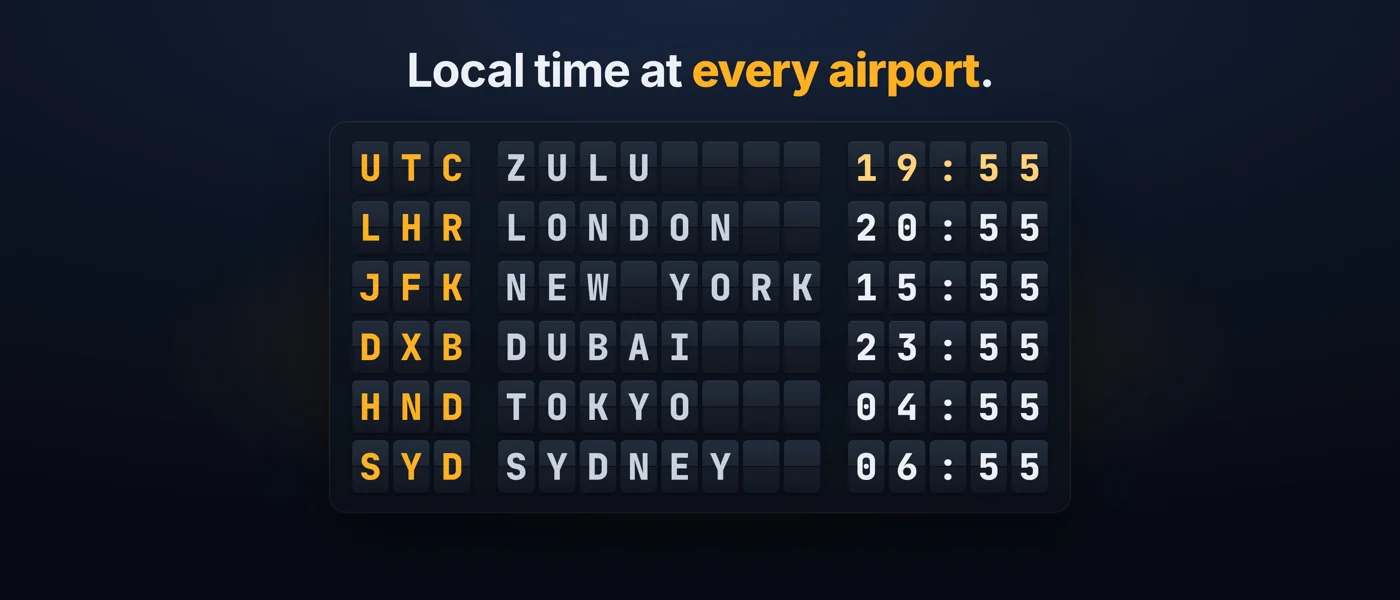
AvClock shows every airport's local time from the same time zone database your iPhone uses, so the changes above happen on their own on the right day for each airport. There's nothing to update, and Zulu sits at the top of the list the whole time.
The new Overlap screen is the quickest way through the odd week. Save the airports you deal with, tap Overlap, and the green columns show the hours that work for everyone, on your own clock. Open it again after October 25 and again after November 1, and the green moves with the clocks. Tap any hour to see what time it is at every airport at that moment. Overlap is free.
Flying during the odd week? Log the trip in My Flights (AvClock Premium) and the departure countdown on your Lock Screen shows your departure time in both local time and Zulu, so there's never a question about which hour it means.
AvClock is reference and informational only, not for actual flight planning or navigation. Always confirm departure and arrival times with your airline and official sources. Dates and offsets above are from the IANA time zone database as of October 2026; governments occasionally change their rules.